Sunday, 17 August 2014

AirSpace Gallery Summer Residencies - #2 PARLOUR by Vulpes Vulpes


Following on from Andrew Burton's investigation of the situation of and possibilities for Brownfield, and its associated notions of physical, and architectural emptiness, the second residency was informed by how we noticed a sense of human emptiness in the City Centre.

Often during the day, but especially after 5pm, Stoke City Centre can empty out a little - the night time economy struggles, and there is a definite sense that people don't choose the City Centre as a place to linger.

After a visit to the City last year, Vulpes Vulpes - a group of four artists who produce work collaboratively and have run a project space in London for the last five years, proposed a residency here with us to explore the notion of "Gatherings" - or social/leisure events as a way to suspend notions of class and formality in favour of a better system - non-hierarchical forms of interaction.

Vulpes Vulpes are: Carla Wright, Anna Chrystal Stephens, Laurie Storey, Hadiru Mahdi
vulpesvulpes.org/

Central to their approach is this text from The Science of Society by Stephen Pearl Andrews (1952)

‘Conversation is continuous, brilliant, and varied. Groups are formed          according to attraction. They are continuously broken up, and re-formed through the operation of the same subtile and all-pervading influence. Mutual deference pervades all classes, and the most perfect harmony, ever yet attained, in complex human relations, prevails under precisely those     circumstances which Legislators and Statesmen dread as the conditions of inevitable anarchy and confusion. If there are laws of etiquette at all, they are mere suggestions of principles admitted into and judged of for himself or herself, by each individual mind.
- - -
Suppose the intercourse of the parlor to be regulated by specific legislation. Let the time which each gentleman shall be allowed to speak to each lady be fixed by law; the position in which they should sit or stand be precisely regulated; the subjects which they shall be allowed to speak of, and the tone of voice and accompanying gestures with which each may be treated,       carefully defined, all under pretext of preventing disorder and encroachment upon each other’s privileges and rights, then can any thing be conceived better calculated or more certain to convert social intercourse into intolerable slavery and hopeless confusion?’ 

photo: Vulpes Vulpes
Over two weeks, there were so many small projects and interventions, meetings and conversations - here are just a few of them.

photo: Vulpes Vulpes
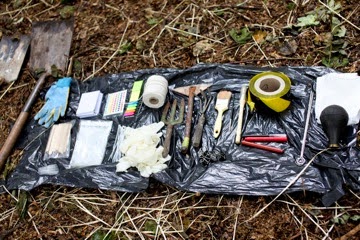
Anna, Carla, Hads and Laurie launched themselves in to the locality - the past and the present - looking at the forgotten fields of Post-Club Rave gatherings - so popular in the City in the 1990's - but now a past memory - Keele Services and Woods, the scene of many a public gathering to prolong a night of clubbing and dancing became an excavation site, as evidence of that inhabitation was sought.


A series of visits to local independent shops produced a brass horn - symbolic of the rally - and a series of conversations with shopholders about the local condition. The broken horn led them to a repairer and further links and conversation.


There was a sports day, exploration of playground, and a children's making workshop - which produced the large multi-media cloud which hung over their presentation, and an outside front-of-gallery free buffet - for passersby to stop awhile and talk about anything.

photo: Vulpes Vulpes


This was an important residency for AirSpace Gallery - we believe in people, and the power of congregation and the social aspect of a city for making a healthy place to live and work. It was great and really instructive to see how VV approached their work, at once serious, critical, political, fraternal and accessible. But moreover, it was the commitment to engagement in, as they are committed to, an all-inclusive way, that really struck.

And on top of that, working with artists who are new to the City, uncoloured by the attitudes learnt from living in it, the perspectives are always fresh. Through the course of their time in Stoke - VV found places, and areas that I was unaware of after a long time living and working here. We can often get stuck in our immediate locales, when there is so much to explore and see, and so many people and businesses to connect with. So, for instance, without this residency, AirSpace wouldn't have become a keen supporter of the local Community Scrap Shack - a valuable local resource indeed.

So, a fitting conclusion to our 2014 residency programme, leaving us excited as to what and who next year's will throw up.

Thanks to Andrew Burton, Anna Chrystal Stephens, Carla Wright, Hadiru Mahdi and Laurie Storey and all the volunteers, and all who came to see the works.

Saturday, 16 August 2014

AirSpace Gallery Summer Residencies - #1 Brownfield by Andrew Burton


Over the last 7 weeks, it's been Residency Season here at AirSpace Gallery. Traditionally, a slow time for Gallery visits, as people take the chance to get away from it all, for the last two years we have programmed two short consecutively running 3 week residencies.

Each one has been targeted at a specific area of interest to us here at AirSpace, and we have seen Natasha Rees examine ideas of Advocacy both within and outwith her own practice, and Hazel France spent her time documenting the City Centre Park ahead of its soon-to-be successful Heritage Lottery Renovation Award.

This year, we had the pleasure of hosting Andrew Burton, and London Collective, Vulpes Vulpes.

2014 Residency #1 - Brownfield by Andrew Burton

We tasked Andrew with an exploration of a neighbouring Brownfield site - once housing a large 3 screen cinema and bowling alley, but latterly laid bare, for a decade, following demolition by new owners Tesco.

Andrew worked tirelessly on the site and in the Residency Space, over his 2 weeks, scouring the land, searching for evidence of a past, in the form of shards of old pottery and bone and becoming increasingly beguiled by the ubiquitous Brownfield inhabitant - the Buddleia. Each of the sculptures and, in fact the whole installation was made from material found on site, and ultimately included up to 5000 buddleia heads.

Halfway through the week Andrew wrote a small piece for our blog, reflecting his thinking about the sate. And reflecting it's clear that at this point his thinking about a final resolution for the residency started to formulate.

Back on site, Buddleia Vale seems quite bucolic today, the yellow pea is flowering like crazy and the ripening grasses and branches of tawny sorrel remind me of harvest time in India. There, in places, the harvest is still brought in by hand, with the heads of corn laid out on rocks to dry before being winnowed. And then the exotic buddleia is like graceful bamboo on the Li river. Strange that a place like this becomes laden with nostalgia when so much detritus lies around. Yesterday I was digging, a shamefully random archaeology. Scratching away at the hard brick strewn earth every meagre trowel full throws up a wealth of worthless scraps – broken plates and saucers, handles (lots of handles), tiny clay cones that are sometimes mysteriously embedded in lumps of clay.

The work I’ve been making is about the space, and it’s about the nature of the material I’ve gathered. What it reminds me of. The simple rule is only to use the stuff I find on site: growing, buried or dumped. (Glue is the exception, though given time and knowhow even that could have been stewed up from roots or leaves, or spirited out of the tar.) I’ve collected a lot, with worryingly little time to take precautions - according to Richard Mabey’s book ‘Weeds’, some of these intruders are so toxic a couple of doses could kill a man. Trouble is, I don’t know which ones. Certainly not much to forage here unless you’re into beetles and ants - the resident cat has licked the crisp packets clean and tins bare and the sorrel is long past being tender.

But all in all, the place is a delight. That old cliché of the pastoral idyll in the city rings true. Pity Tesco is selling it off. There’ll be a car park here soon. -
 Andrew Burton

I just did a residency with AirSpace Gallery, which was brilliant. They wanted an artist to reinterpret a 'Brownfield' site - basically a demolition site strewn with thousands of old bricks and lumps of road which had been chewed up and dumped - it was an old cinema before. But it turned out that what interested me was not the bricks, but the buddleias that were growing there. They were just coming into flower. We picked thousands of them and they formed a kind of base for a set of small sculptures made out of wood and stones. Buddleias don't stay that amazing zinging purple colour for long - they turn brown and sort of shrink up in a few days. That deterioration from purple to brown, insects crawling out, and nature retreating and changing was a kind of involuntary performance.source: http://sculptorvox.com/andrew-burton/ 


For us, the importance of this work is in the representation of the possibility for portions of urban space to be given way to natural green space - and space for people to linger. Provincial City Centres are at risk, as an emptying out process due to a change in shopping habits, means that Planners are going to be tasked with reimagining the point of the urban centre. We have to find reasons for people to stay in our centres once they have come.

Through this residency, Andrew has shown that by harbouring the before-our-eyes successful example shown by natural reclamation, beautiful managed city centre green spaces can be created. City centre Land is expensive. This site is up for sale now for £400,000. Land Use of this sort may not make money in and for itself,  but maybe if they help attract people to the centre, and crucially, give people a reason to stay longer than a quick determined visit to the shops, then they can have a slow release economic benefit to the benefit of lots of surrounding shops and businesses.

Not to mention a sense of cultural, social and pastoral benefit and well being.

Really interestingly, Andrew's Residency and his Presentation has kickstarted a determined conversation about the possibility of a community buy-back for the site - whereby, we might stop its conversion to another shop or car park, and find a greenspace future for it. The chances for this may be slim, but who knows?

It was great to see how Andrew was able to work in a new way, with new materials, to the brief in such a short residency, and still push his practice, despite his long working  experience, when it might have been tempting to play it safe. And the resulting majesty of his "Buddleia Vale" was wonderfully evocative, suggesting a real possible solution for a future for the Brownfield site - and a testament to his skills and endless endeavour.

When we designed these short residencies, we were unsure about whether the short time period might inhibit work of any scale or depth. This residency proves what is possible, and the creative impetus that concentrated working can inspire.

Thursday, 14 August 2014

PARLOUR by Vulpes Vulpes - Excavation by Hadiru Mahdi


#7 in a series of blogposts from VulpesVulpes reflecting on their AirSpace Gallery Residency activity for  PARLOUR

Words: Hadiru Mahdi
Images: Anna Chrystal Stephens

Excavation


Some gatherings move from impromptu into permanence. I wonder if it is possible to chart the movement between, find the turning point. I reckon not, likening it to when a sprained wrist or clicky knee is such a fixture that you prepare yourself for living a life defined by it. Only to realise in its absence, how it passed so quietly, you would have rather had a chance to mark it, to celebrate the freedom.

The focus point may be ceremony, or site. Habits turning habitual. For the past two years those who know me well can find me on a Wednesday, though the day and location has sometimes changed, they will know what. This certainty, broken briefly at times by factors outside our control, was never the result of plan or intent. It developed I feel, through the value of experience and interaction, openness ,joy, vibes. The hesitation to recreate or recapture dissipated, replaced by trust in what had been built.


There are signs of course, when see you next week changes from a question to a statement. When you stop checking whether someone will be there; if they are not you don't fret, fully expecting to see them again. When you yourself feel become spatially reliable.

Music is a great gatherer, what I describe above is a jam session that grew from a suggestion to a force. During this residency I have been drawn to the musical cultures of Stoke, the tribes and scenes, the shrines. From the seemingly endless supply of cover bands, to the Northern Soul all-nighters and stories of queues round the block for Acid House raves. When world-renowned DJs were in residence, records sought and traded in car parks, and landlords accepted Amphetamines in lieu of rent.


I find myself thinking about the abruptness with which these moments shifted from permanence to past tense.
The rest in peace dates. The closure of Shelly's Laserdome, the end of Jollies, the last all-nighter at the Golden Torch. The resistance. When police involvement, planning permission or licensing proved too hard to navigate, too stifling. The come down. After people grew older, sought direction or stability, had children, moved away. But also the revivals, the originals still in stock at Rubber Soul Records. The all-nighter on October 4, King's Hall, Stoke-on-Trent. What memory might be stored in the hallowed grounds of the places that gave us these times? If those shopping at Lidl only knew what Sasha did in the car park


Some sites are still here, as they were then, the product of coincidence or better confluence, and ending when the sources and springs dried. Up until -the mid-90s, on the M6 between junctions 15 and 16, Keele services served as a convergence spot for revellers travelling north or south after the clubs had put out and those leaving the forest knowing they better now than spend the night. The cars pulled up playing tapes, recorded sets for which many were there, that mix, that drop, a flashback, the body tingles in muscle memory.
That Fiesta, a deep metallic purple, four doors open, drinks out the boot, is from above a Scarabc displaying wings and circled by admirers, moving. More cars arrive and come to a rest on the rock. You stopped first just because you were bursting for a piss but are here two hours later, another half, go on. Jonny's gotta drive to Chester and sleeps with the driver's seat back, how the hell he can with the music at full blast you'll never know. That's a skill that. Those who stumble upon it for the first time are already crafting the story in their heads to tell the friends who continued home or never made it out. But not to say I told you so, I'll take you next time. You leave at dawn, are in your city after sunrise and still up at noon. The only service you ever used was the loo, never caused any harm, were always polite and courteous to the staff, made friends of them, brightened their nights.

On our pilgrimage we excavate in a woodland clearing, searching for remnants that would carry us closer or take us back in time. I am not sure I expected to find anything or if we did, what it might say. Yet, the seemingly banal left us astounded - a Bounty wrapper nearly 20 years old, a marble, a pill case - they were boundless, leaving us with freedom of thought and imagination. I saw faces, friends and strangers in the high grass between the clump of trees, where they searched but had no torch, nearly a decade before someone might be relied on to have a phone light. 

The nostalgia I realise was mostly my own, though it was only partly of the melancholy and sickness that word may describe. I am lucky to be able to imagine through living in part a phase of that history. In Yorkshire, Lancashire, London and places I could never again find on a map. I sat in circles with people I cannot otherwise imagine ever encountering and talking to. I value and hold dear those exchanges and feelings, of being open, trusting and welcoming in. It is why I would now rather ask than assume, why I might meander in conversation, take time, start again, knowing that there is something in there that I can learn from, that we share. Why remembering all this is necessary and shows me that I still at times am lacking, because really it was the people that made it be and so it is them I must call on and not only to reminisce, but to see what's happening now.

It's the muscle memory and emotional recall. Why we still rave to jungle and garage as I remember humming bass lines in South London primary school playgrounds. How Kabal in Sheffield is at once then and now. An education through which I found admiration and the want to honour the pioneers and creators, how I wanted to be true to them, acknowledging my position is but a little mark in history bigger than me. Why we say respect the space. Why my friend throws an acid house party on a Monday night in East London begging someone to tell him it isn't right

this one you