Tuesday, 2 April 2019

Organisational Development: Visit to PEER, London


The last of our organisational development visits was carried out by Rebecca Davies. In March, she met with Alice White, Curator for Local Audiences, at PEER - an independent arts organisation based in Hoxton in East London. "Peer has evolved from the ground up over the past 20 years, putting down deep roots within the socially, culturally and economically diverse area of Hoxton.."


- We don’t exist in isolation. We are public. -


I arrive at PEER on a sunny Spring afternoon.

During the morning, I’d been exploring/making the most of London and time with my brother who was over from Germany.

We start at the Lisson Gallery – both spaces.

I stand outside in awe of their purpose built architecture – something I am becoming increasingly mindful of. Why? Because AirSpace was not originally built to be a gallery – not sure what it first was, but it became a resting/safe space for young women suffering from domestic abuse. Then it was a bank.

Now it’s AirSpace – Gallery and Studios. And a great job has been done to turn it into exactly that, despite my feeling sometimes the building makes it a bit of a challenge.

Lisson has shit loads of money: its an incredible space to view work, to show off the work it has on its walls and plinths AND, in the case of this particular show we saw, warts and weaknesses (gaah it was so boring – apart from one piece that was basically van Gogh postcards in a frame).

We moved on to The Approach – a small gallery space above one of my favourite East End pubs. Definitely NOT built to be a gallery, and I’m sure some of the Eastenders old and new are surprised there’s white walls, and meticulously placed expensive artworks right above the space they lovingly refer to as their local. Nevertheless, it’s a beautiful space and nice to hear the hum of afternoon pint drinkers climb it’s way up the stairs and provide (me anyway) comfort while looking at the art.

A bus ride from Hackney Road to Old Street.

A short walk through Hoxton Square.


The old White Cube looks derelict – now surrounded by gourmet burger cafes and cocktail bars. Some people ACTUALLY LIVE on Hoxton Square. EU Flags hang in the door way of what looks like a sexy design studio. I’m not digressing, I’m trying to set the scene, because then you’re on Hoxton Street and outside PEER. Where it feels so, so, so different to any of that: just a five minute walk from the terrifyingly polluted and noisy Old Street Roundabout there is a neighbourhood. And there is PEER.

The Khadija Saye Garden is blossoming and a luscious green (I learn later that Khadija was once a gallery intern at PEER and the garden is a memorial to her after she died in the Grenfell fire). Two trees with circular benches are full of college students, and skateboarders are utilising the spacious pavement outside the gallery - which, to the passing public, is two giant windows from ground up. The invigilator beams and stands up from her chair (not behind a desk) when we come in. We like the exhibition – but we’re struck even more by the action and life outside. It feels like a two-way viewing space. The pavement is a stage, but to those sat on the benches in front of the gallery, we are onstage.

I say to the young woman invigilating that I am here to meet Alice, but know that she’s tied up right now having a meeting at the local sixth form college. "So I’ll just hang out here till she arrives," I comment; "oh in that case… would you mind filling out a feedback form? It won’t take long," she responds. It is actually quite lengthy, but I am pleased to provide some feedback and take photos of some of the pages on the i-Pad she’s passed to me.

I happily share why I’m there, when I was last there, why I went last time, who I am, where I live – because answers to these questions, I am learning, are very important if you are a gallery that wants to listen to people and create a space which tries to engage its audiences – or represent and engage better with the ones it might not be. She tells me she went to the local Sixth Form and it was through a talk that Alice gave at the college that she heard about opportunities at PEER to work – PAID – in the gallery.
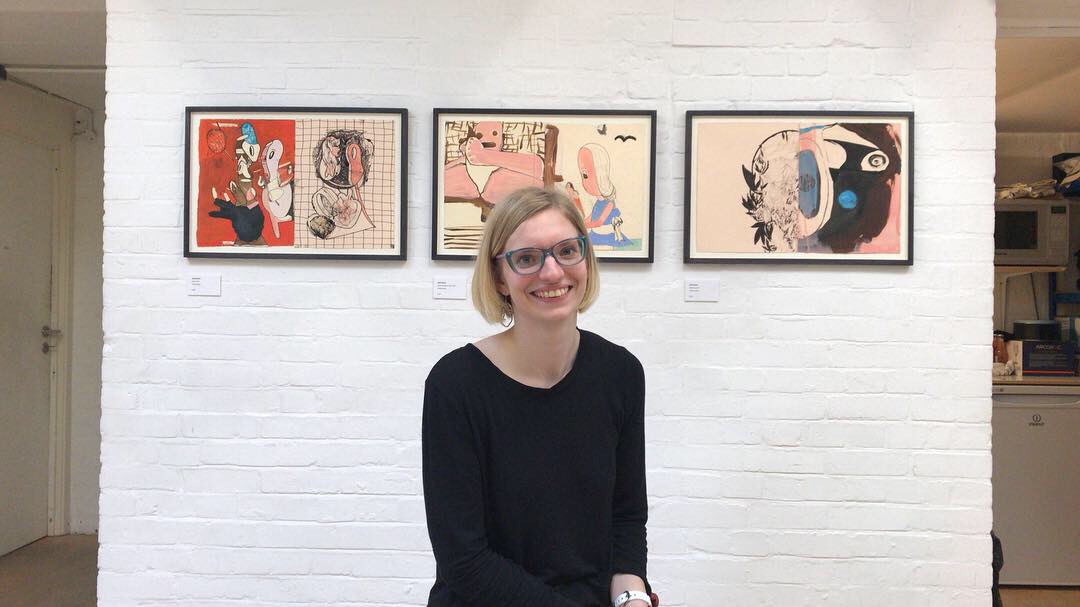


Alice arrives and we go through to the back – a smaller space with a video playing and PEER’s edition prints of artist works are hung on the walls. She makes me tea and dries the cups using a tea-towel that hangs from a cat’s bum tea-towel holder in the kitchen.

"I’m a curator FOR local audiences. Not OF. And people often say OF. But it’s FOR - they’re local PEOPLE I work with. NOT objects." She has said this to me before (we are currently working together on a project in Barking and Dagenham with social services.) "PEER sits within the community, down the street from the library, a social housing estate, next door to a post office, it’s on a street where there are other cultural organisations, cafes, restaurants, newspaper shops, hairdressers, bakers, a funeral director and a Poundland. We don’t exist in isolation. We are public." One wall of the gallery is pretty much a window – "..the hope is that outside will know about what we’re doing here and be able to look in."

PEER maintains a core ethos to make ‘art part of daily life’ – I instantly think of the beautiful street clock that Chris Offili made with them, standing outside the gallery.


A brief introduction to the gallery’s Director, Ingrid Swenson MBE (for services to the arts in East London) actually turns into a much longer discussion with her about NPO – PEER surviving on 5OK from its first three years as an NPO – it being difficult for some time, but how she’s glad they went for it. We plan a PEER trip up to Stoke – the potential of AirSpace being a location for their touring shows is discussed, and Alice and I go back to the space where we’d started our conversation.

There is a map of the local area titled ‘Adopt a Tub’ – it sets out the locations for bath tub planters across the estate – a recent offsite project that Alice has been leading on with an artist and a gardener. Alice recently successfully applied for Paul Hamlyn funding with the gallery – a sum of money that covers her leading PEER Ambassadors (enabling young people to get paid Gallery Assistant experience) and PEER Notices (a year long public art project on Hoxton Street across a year; allowing deep and embedded relationships to form with place and the people who live, work and study here,) thus "pioneering projects across two years that aim to provide opportunities for local young people from BAME and lower socio-economic backgrounds and artists to work together on public art projects."

This is great news and means Alice can continue collaborative activity, like the Adopt a Tub scheme, in the local area. Alice is passionate about such collaboration, and about PEER working with local residents, "it’s where they live; they have the power to shape it." It’s clear how important it is to her that people locally feel like PEER has got their back, "because some people feel powerless in their home situation." This has meant that Alice’s role at the gallery includes going off-site a lot, meetings and projects at the local college, attending Local Ward meetings. And we discuss the politics of this, the level of responsibility Alice has for locals working on these projects, how involved she can or can’t get when situations between residents and the council arise – and how important it is for her and PEER to represent those residents when they too are a neighbour. "Residents ask you to fix things," but that’s not Alice’s job. Is it?

For me, working in a similar way on projects, i.e The Portland Inn Project, it’s about putting the pressure ON. Not taking it off. To be truly collaborative is about solidarity – and there are certain things that cannot be fixed in this way – that is the job of local services/the council. "Sometimes," Alice continues, "there are snapshots of a failing system, but then you see small moments of great things happening."

These conversations with Alice, I don’t doubt, will continue (I hope) for years. I think we both see sharing this knowledge as a vital way of our learning methods of best practice. PEER is important. As far as East London galleries go, it’s quite an exception. It listens, it works with, and is truly neighbour to the area it sits in – and Alice’s role is imperative in that.

Thank you to Alice White and PEER.

www.peeruk.org.

This activity has been funded as part of an Arts Council England National Lottery Project Grant.

Saturday, 30 March 2019

AirSpace Gallery Programme Evaluation 2015-2018


https://drive.google.com/file/d/1zRusc1aN4LSj5LRL0iL4vE27bRXCnyPS/view?usp=sharing

AirSpace Gallery Programme Evaluation
For the period September 2015 – September 2018
by Selina Oakes


In order that we continue to offer the city a relevant cultural output, we tasked arts researcher and writer Selina Oakes with an evaluation of our activities at the end of the Gallery's 2015-2018 Arts Council England funded programme. Through detailed research and feedback from contributors to the programme, and our physical and remote public audience, Selina has provided us with a comprehensive reflection, confirming what we are doing well, and identifying areas for improvement, which we will seek to embed into our future thinking. 

To download the full pdf click here 


Thursday, 14 March 2019

Organisational Development: North East Group Visit, The Newbridge Project


On Saturday 16 February, we visited The Newbridge Project site in Gateshead. Founded by two Newcastle University graduates in 2010, The Newbridge Project has grown, changed form and changed buildings since then. Currently, it is split across two sites – one in Gateshead and one in Newcastle. We meet with Director Rebecca Huggan to chat about the organisation's development, its changes to a charity and more recently an NPO.
Glen Stoker notes: “It [The Newbridge Project] is an interesting arts model built on the provision of studio space and an artist community-resourcefulness which acts as a motivator for their programming. NewBridge occupy two buildings and have recently moved one of their studio blocs to a new building in Gateshead. Their business model is built on having a lot (100+ over two buildings) of low-cost studio provision to cover all business overheads.

Staffing and Salaries
There are currently two full-time members of staff: a Director, who is largely tasked with organisational stability and programming strategy, and a Programme Director, who looks after the gallery programme and off-site public programme. There are also two Co-ordinators – an Artist Development Co-ordinator and a Studio Programme Co-ordinator – who operate three days a week each. Salaries made up from various income streams such as NPO funding, support in wages from Newcastle University and studio income.

Gateshead Building
  • The new building layout gives over 90% to studios with a small exhibiting space at front of building
  • Newcastle University architecture department delivered plans for this building – for no charge – as part of NewBridge’s Early Career Artist Programme which is supported with funding by the University.
  • The delivery was carried out through an ACE Grants for the Arts commission by TILT, a technician & artists services organisation – the space was built in three weeks.
  • Important inclusion of a large social space, with open access to the public, makes for a good communal atmosphere and attractive to studio seekers
  • Felt that they had to move from being a CIC to Charitable status to be eligible for business rates relief following move to new council-owned premises.

Studios
  • The studio revenue from the two buildings (in Newcastle and Gateshead) is £85k per annum. This income allows for solid match funding and a steady cashflow. There is also a selective application for studios – asking for evidence of work and why they want to be part of, and how they can contribute to NewBridge. This acts as evaluation/ provides evaluatory material for funding reports.
  • Studios are always at 100% capacity with a waiting list of around 60 – showing that there is studio demand in the area
  • Some studios act as residency space
  • They have difficulties with the environment of their studios – particularly the cold – but their cashflow enabled them to sustain themselves and install a new heating system.
  • Studio holders have a tenancy agreement and contract, and pay a £50 deposit upon entering their studio

Leases
  • The Newbridge Project only has a 3-5 year lease – so there is a sense of impermanence and precarity as it is a lot of work to move 100+ studio holders to a new building for an acknowledged short amount of time. This frustrates existing studio members to some extent, though, there is a general understanding that this is just the way it is all across the city: all of the studio providers in the city - Northern Charter, B&D, Ampersand, Breeze Creatives - are all on short term, temporary leases - so generally all the city’s artists are in the routine of regularly moving studios.
  • Most of Rebecca’s time is spent searching for a building with a longer term lease. Aconversation to access a new City Council-owned building with a 25 year lease, big enough to house both current building’s worth of studio artists has just fallen through after 12+ months of negotiation - so now looking at new options, is it feasible to buy a building?
  • The area they’re looking for buildings is problematic. Most artists want studios in Newcastle, and even though Gateshead is only 10 minutes walk from Newcastle centre, the perceived poor transport infrastructure (public and private) deters people from Gateshead as a location. 9/10 of prospective studio holders state a preference to be in Newcastle rather than Gateshead.


Running an Arts Organisation on Studio Provision

“It is clear that there is a successful model here for running an arts organisation based on its studio provision. The business model is built on a steady large scale revenue stream from its studios, which in turn, opens up access to other funding bodies. There is almost a readymade supportive community made up of the artists inhabiting the studio spaces, meaning there are plenty of resources to tap into. The potential for the associated gallery programme is rich with professional development possibilities for the studio community and it is clear that the human resource-rich nature of the organisation is attractive to the artists Newbridge work with. There are clear links with and formal support from the University and its culture department - as the benefits in terms of attraction for new students is clear, and the prospects for graduate retention are high. A symbiotic relationship, which ought to also offer the ability to sway the political stakeholders as to the worth and value, both socially and politically to this level of cultural activity.

Whether this sort of model could ever be transferrable is moot, as it relies so heavily on some basic fundamental infrastructural realities - namely stakeholder support, a critical mass of practitioners and a healthy and vibrant, dynamic and fraternal cultural eco-system. However it is clear that if these conditions exist, this model is not only feasible but desirable. It is clear that in the case of Newcastle and Gateshead that these conditions exist - and is further helped to by the presence of a high quality, supportive arts institution - The BALTIC, who appear to understand the worth of and necessity for grass roots, artist-led activity in support of its activities and as an essential element of a city’s cultural offer.” - Glen Stoker

Public Programme
We continue the conversation by speaking about Newbridge's Public Programme. At present, Newbridge receives some support from the Newcastle Cultural Investment Fund which is put towards an offsite commission. Rebecca notes that, a few years ago, Newbridge delivered Hidden Civil War, which comprised of 20 events in one month. It focused on austerity politics and presented existing works. Following this, Newbridge has decided to slow things down: to deliver less but to commission new works which are responsive and more embedded in Newbridge's overall output (Rebecca's points to the more recent Deep Adaptation as an example).
Newbridge's Public Programme exists alongside the Exhibition programme. It focuses on a) its public audience and b) support for artists. The PP in itself can be divided into public-facing and an associate scheme, the later of which is called Practice Makes Practice - an artist development programme run by artists for artists and the wider arts community. PMP is given structure by a steering group and regular activities managed by the PMP Coordinator. They have communal soup meetings once a week and specialists workshops such as lifedrawing once a month (which attracts 60 people each session). PMP focuses on developing artists as people who are part of a community.


As with most artist-led spaces, volunteers play a crucial role. At present, Newbridge has an informal placement programme whereby volunteers are able to gain membership to PMP and discounts on space hire. As well as its studio members, it also has “Hot Desk” members who pay £25 per month for flexible desk space and a key to the building. It could be beneficial to AirSpace to begin an Associate scheme - similar to PMP - to generate a 'returning' audience and community, as well as introducing a Hot Desk membership (or Resource Room) where people hired out the space on a regular basis for a set, annual membership fee. This would form part of the gallery's Public and Outreach programme.