Showing posts with label THIS MOVEMENT. Show all posts

Wednesday, 30 March 2016

Decapod/THIS MOVEMENT: A partial history of THIS MOVEMENT in Staffordshire

THIS MOVEMENT is not new.

THIS MOVEMENT has been operating in Staffordshire for hundreds of years.


Perhaps one of the oldest manifestations is The Abbots Bromley Horn Dance, thought to have originated in the pagan period when the ruling dynasty of Mercia (based Tamworth) owned extensive hunting lands surrounding Abbots Bromley. The royal forester choreographed magic rituals to ensure good hunting and as the tradition continued into Christian times it become a way to affirm the villagers' hunting rights.

Abbots Bromley Horn Dance. 1930 - 1939 (c.)
Reproduced by kind permission of Staffordshire Achieves and Heritage Service


Another movement with pagan origins is the Maypole Dance which has been appropriated by various causes. For example this 1911 dance in Walton-on-the-Hill, Stafford formed part of the Parish of Berkswich celebrations for the Coronation of King Geroge V and Queen Mary.

Maypole Dance, Walton on the Hill 1911
Reproduced with kind permission of Martin Husselbee
More commonly May Day has been the focus of workers' solidarity movements. For example here is a photograph of a 1908 Labour Day demonstration, featuring Miners' Trade Union banners. The demonstrators are marching up Stafford Street, at the corner of Clayton Street in Longton, Stoke-on-Trent.

Reproduced with kind permission of The Potteries Museum & Art Gallery

It is around a similar period that we see local workers performing company-organised movements. For example here is a group of female workers from Lotus Shoe Makers Ltd participating in a dance and exercise class on the company's sports field on Sandon Road in 1924. Lotus, like many other companies, encouraged their employees to participate in sports and social activities and a Welfare Superintendent was appointed after the First World War and activities included gymnastics, bowling and dramatics. (Two years later Stoke-on Trent's workers would join the rest of the country in a general strike, one of Britain's largest choreographies).

Keep Fit Class, Lotus Shoes, Stafford, 1924.
Reproduced by kind permission of Staffordshire Achieves and Heritage Service

Back in 1924 Stoke-on-Trent was one of several cities that refused dance licenses on 11 November at a time when there was a split of public opinion about whether Armistice Day should be one of celebration or mourning. The former eventually won out but here we see how movement becomes a site of political contest.

Movement is also a site of religious struggle, as demonstrated by the development of methodism in Staffordshire.

Primitive Methodism was a purist form of Methodism that broke away from the Wesleyan Methodist Church, It emerged in Staffordshire in 1811 from the merger of Hugh Bourne' 'Camp Meeting Methodists' and William Clowes's 'Clowesites'.

Clowes was born in Burslem in 1780. and up into his 20s he was an accomplished dancer, at a time when (according to his biographer William Garner) "the youth of both sexes exhausted their mental and physical powers in the light fantastic step and mazy dance. Scientific skill and practical expertness in this fashionable, unhealthy exercise, were regarded as fine accomplishments." 

Extract from William Clowes's journal
However "dancing was usually associated with taverns and alehouses of low reputation. Intemperance, quarrelling, wantonness, and midnight revelling, were the order of the day." Clowes was also a bit of a troublemaker and in 1804 he gave this all up to convert to Methodism.

Nevertheless he continued to dance as part of his evangelism and his embodied knowledge no doubt shaped his involvement in the 'camp meeting' movement. Frowned up on mainstream Methodism, these day-long, open air meetings involving public praying, preaching and Love Feasts.

Methodist camp meeting (1819 engraving)
And so THIS MOVEMENT continued in Staffordshire. Through ballroom dancing, disco, migration in and out of the city, Northern Soul, strikes, raves, demonstrations and hundreds of other individual and individual and collective movements.

Friday, 18 March 2016

Decapod/ THIS MOVEMENT: A reader

THIS MOVEMENT wonders how we might think of things like dancing and things like protests as being similar in some ways. It believes that both have an aesthetic and a political character and that aesthetics and ethics are two sides of the same coin.

These are not new ideas and here are a few other sources that you might find interesting or inspirational like I did.


'Dance and difference: Everyday practices for the future citizen' is an essay by Daniel Baker in the book The Future Citizen Guide published by Tate gallery after their Future Citizen Forum event in 2014. Baker was undertaking a three-year research project exploring cultures of dance amongst older people across London, combining anthropology, art practice and performance. I picked it up in the Tate bookshop last year and was really excited to read how he framed these kinds of social dances as a practices that "enable an open, exploratory citizenship." It's not that widely available but it's on my bookshelf (with a black spine).


Book of Recommendations: Choreography as an Aesthetics of Change is maybe the first book I read that opened me up to these ideas. It's a short but profound book (I have it on my shelf in the gallery) written by Michael Klien, Steve Valk and Jeffrey Gormly that reimagines choreography -- as an 'aesthetics of change', something that "assumes the creative practice of setting relations, or setting the conditions for new relations to emerge". You can read it online.


Susan Lee Foster's 2003 essay ‘Choreographies of Protest’ takes a look at three nonviolent protests in recent US history—the lunch counter sit-ins of 1960s (pictured above), the ACT-UP die-ins of the late 1980s, and the Seattle WTO protests in 1999 - asking of them the kinds of questions that a dance scholar might ask: What are these bodies doing? What and how do their motions signify? What choreography do they enact?

Jaana Parviainen's 2010 essay ‘Choreographing Resistances: Spatial-Kinaesthetic Intelligence and Bodily Knowledge as Political Tools in Activist Work’ is also worth reading, taking a similar approach, analysing three choreographies of resistance.


Adam Curtis's 2015 documentary Bitter Lake looks at how Western politicians tell increasing hollow stories rot try and make sense of an ever confusing world. He does this through a history of Western interventions in Afghanistan but what is particularly interesting for me is how he uses a motif of dancing (also worth looking out for the recurring images of smoke) to tell a literal and metaphorical story.  It's over two hours long but well worth it and you can still watch it on iplayer.

Wednesday, 16 March 2016

Decapod/THIS MOVEMENT: Choreographic objects

Another part of THIS MOVEMENT is objects. Movements involve objects after all and I wondered what it would be to have objects that referred to an ambiguous movement that perhaps doesn't really exist, or perhaps runs through other movements. I didn't really have much of a plan (this was early 2016, before I even knew I was coming to AirSpace) and thought that if I got them they might lead me somewhere.


The first thing I got was the two placards that are in the gallery. Placards are the total 'political art' cliche. Mine aren't even cool ones that I hand painted or made roughly. I ordered them online late at night when I was bored.  

I also got some button badges. I've been looking for a reason to get badges made for my work and here was one. Badges get picked up and worn and spread and I fancifully imagined that THIS MOVEMENT would spread with them. (You can pick up a badge from the gallery)

I got these pencils too.


I'm also interested in how objects choreograph us - how they invite or require a certain kind of movement. There was a disobedient objects exhibition at the Victoria and Albert Museum in London a few years ago that touched on this but it's not just about choreographies of disobedience or resistance.


It's also about objects of support and care and cooperation which are ideas I am interested in as a basis of politics.


So I've been gathering water bottles, and blankets and ski masks (yeah I know, Pussy Riot have claimed these for a long time now although my reference was James Dean Bradfield) with no particular purpose in mind. Pink (or close enough) is the colour for no particular reason apart form the fact that is pretty and not so common but not too hard to find. 

And Gene Sharp the influential thinker on non violent revolutions includes symbolic colours amongst his 198 methods of non violent action.


And then last week I started photographing them but quickly realised I needed to show them in action. Duh. Maybe this is the start of something. It's the first time I've put myself in the frame for a while which is strange and something for me to think about.


Tuesday, 15 March 2016

Decapod/ THIS MOVEMENT: Library

One of the things I wanted to do in this residency is to bring the books that inform my interest in dance and politics.

As well as looking nice, the books are arranged in colour as a way to disregard the traditional library categories. I tried curating a selection of books about embodied thinking in a public library a few years ago so it sort of comes from there.

I'm also interested in sharing resources (perhaps because I feel like I have few myself), and wondered if other people interested in these things might want to use at a resource for their enquiries. For your enquiries. Perhaps it needs longer than a month to settle in or it needs some activation - maybe you (if you are in Stoke) know some of these books and can offer a recommendation?


Monday, 14 March 2016

Decapod/THIS MOVEMENT: Gifs

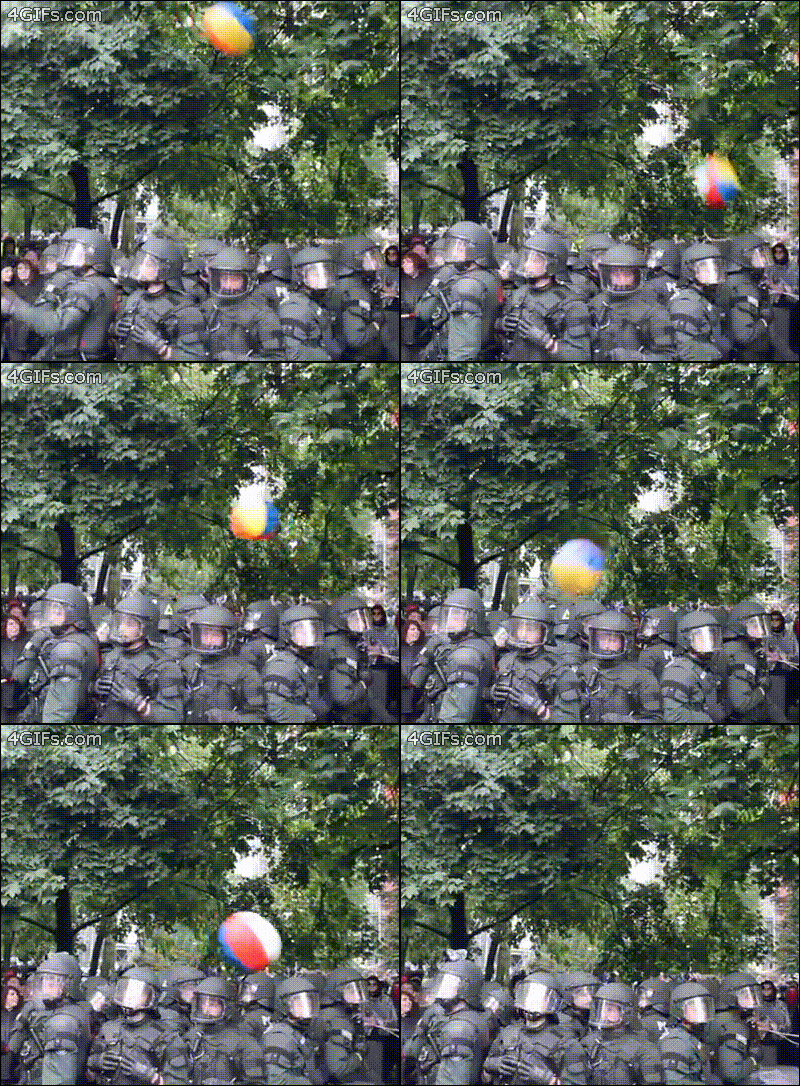
One of my research tools for my residency is making gifs although they haven't been featuring as much as I had thought they would.

I like how these short looping images draw attention to small details or movement and, when placed alongside each other they allow connections and comparisons to be made between different situations and scales. Between human and non-human. Finding and imagining the different patterns of movement that run through all things.

Here are some I've made so far. You can follow future ones on my Twitter account.

Sunday, 6 March 2016

Decapod/ THIS MOVEMENT: Beginning


Hello. My name is Hamish MacPherson and my Decapod residency at AirSpace began this weekend.

I'm a London-based choreographer who makes performances, installations, workshops, games, writings, images and other things. My work often deals with dance and choreography as technologies for being and thinking together with other people. I'm interested in revealing the embodied aspects of systems like politics and philosophy that might otherwise appear abstract or neutral.


I'll be up three of four days a week throughout March to use the gallery as a base for my practical research project THIS MOVEMENT, working towards finalising a brand new piece of work to be shown at a later date.

My desk is at the back of the gallery.


THIS MOVEMENT is how we use our bodies to make politics. 


It's not affiliated with a political party or even big P politics in general. 


It's more about how we're using our bodies to be recognised, to organise (or disorganise) ourselves or to make change.


I think it's happening all the time: protests, demonstrations, parades, occupations, sit ins, walk outs, illegal raves, clubbing, rambling, folk dancing, playing, running, BDSM. We can think of all these things as being political.

Former Magistrates Court occupied by protesters in Stoke-on-Trent 2014. 
Photo: scfcbushy

The core of what I'd like to do is interview people in and around Stoke who are or have been involved in this kinds of bodily politics. It only takes a little bit of internet searching to find there has been lots of this taking place.

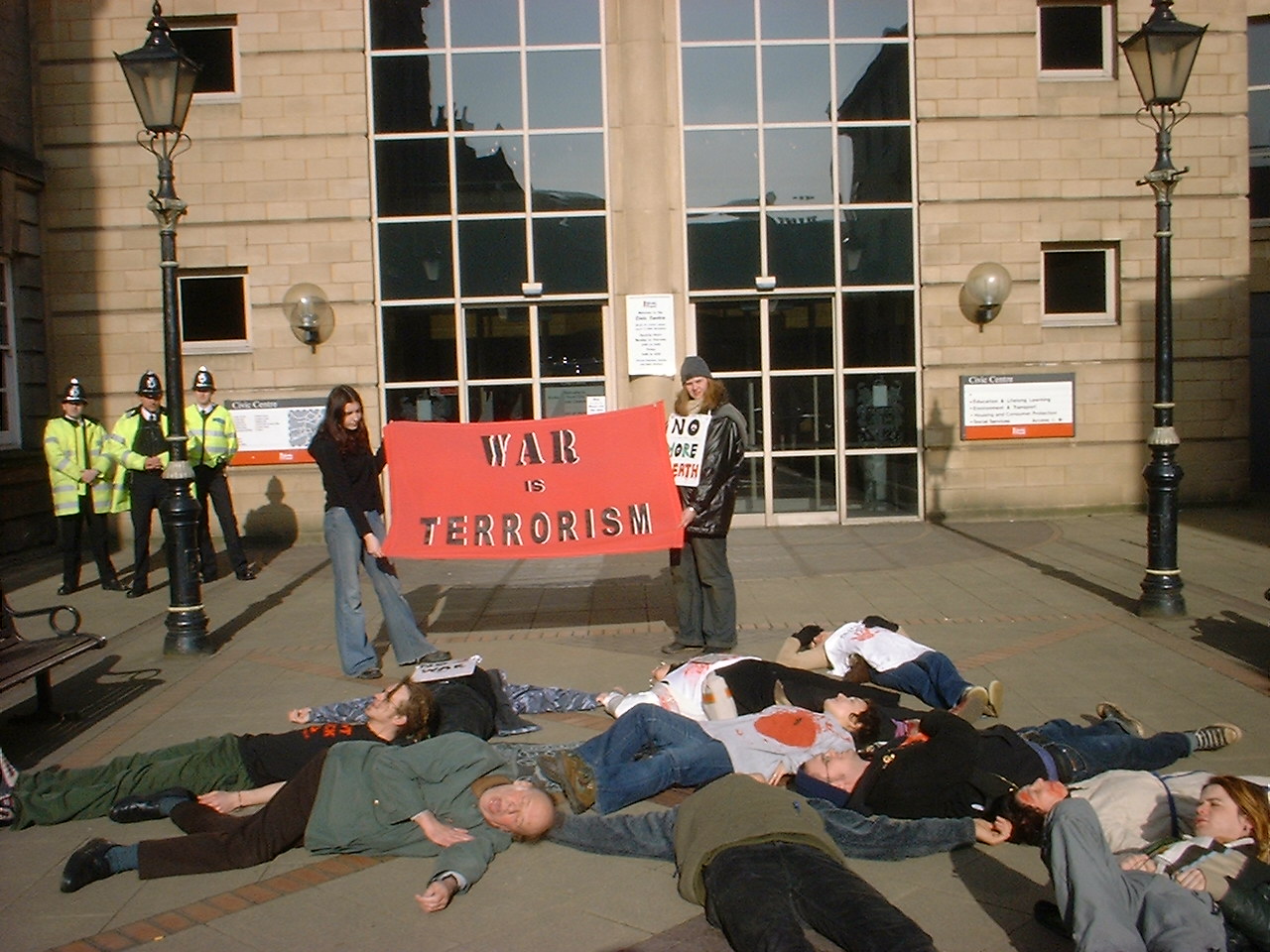
Stoke-on-Trent demonstration and 'die-in'
Stoke-on-Trent demonstration and 'die-in' 2003
Photo: Thomas J

During my residency at AirSpace, I want to think about some of these ideas in the particular context of Stoke on Trent. A month is not long at all but when I'm here I'll be using a range of research methods including, interviewing local people, running, swimming, dancing, practicing yoga, taking photos, making GIFs, blogging, facilitating some post apocalyptic dance training and setting up a public reference library in the gallery.

Abbots Bromley Horn Dance

On the latter, please feel free to come into the gallery to read the books on the shelf. I'd like them to be a resource for other people interested in dance and politics while I'm here.


If you would like to find out more, be interviewed or be involved in some other way you can visit me in the gallery, leave a note on my desk or email me at info.thismovement@gmail.com